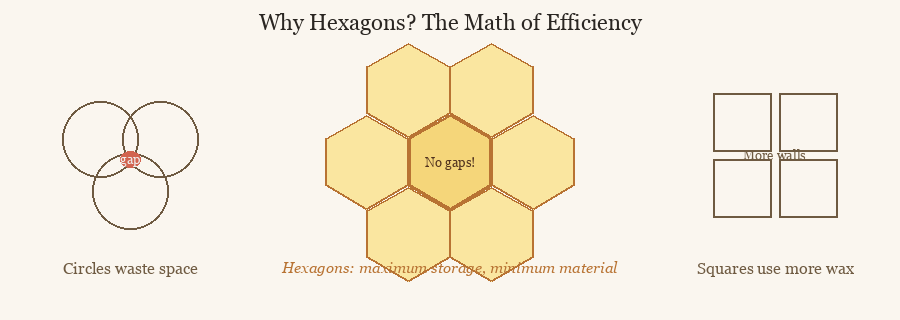
The honeycomb conjecture: hexagons tessellate perfectly while minimizing perimeter per unit area
Imagine building a cathedral in complete darkness, using only your mouth and wax secreted from your own abdomen, with no blueprint, no ruler, no level — and yet constructing cells so geometrically perfect that they differ in size by less than 2%, arranged in patterns so precise that mathematicians study them.
This is what bees do. Every day. In the dark.
Wax comb is one of nature's most elegant structures — a solution to the problems of storage, strength, and space efficiency so perfect that humans have been copying it for centuries. Let's explore how bees create it.
Beeswax doesn't come from flowers. Bees manufacture it themselves, using specialized wax glands on the underside of their abdomens.
Workers aged 12-18 days have fully developed wax glands. When the colony needs comb (to store honey, raise brood, or expand), these young bees gorge themselves on honey — because wax production is metabolically expensive.
The conversion rate is brutal: bees must consume about 8 pounds of honey to produce 1 pound of wax.
After feeding, the bees cluster together in a living curtain, hanging from the top bars or existing comb. They link legs, creating a stable platform. Their body temperature rises as they metabolize the honey. And then, slowly, wax begins to appear.
Tiny wax scales — translucent, white, each about the size of a pinhead — emerge from pockets between the abdominal segments. The bees pluck these scales with their hind legs, pass them forward to their mandibles, and begin to chew.
A bee chews the wax scale, mixing it with saliva and secretions from her mandibular glands. This softens the wax and makes it malleable. She presses the softened wax into place, molding it with her mandibles and legs, building up the comb cell by cell.
She doesn't work alone. Multiple bees collaborate on the same section of comb, each adding material, shaping, thinning, smoothing. The process is decentralized — no foreman, no blueprint. Each bee makes local decisions based on what she senses around her: temperature, pheromones, the shape of neighboring cells, the tension in the wax.
From this chaos, order emerges.
Bees build hexagonal cells. Always. Not circles, not squares, not octagons. Hexagons.
Why?
Because hexagons are the most efficient way to tile a two-dimensional plane without gaps, using the least perimeter (and therefore the least wax) to enclose the most area.
Mathematicians call this the "honeycomb conjecture," and it took until 1999 to formally prove what bees have known for ages: the hexagonal grid minimizes material while maximizing storage.
A circular cell would provide more volume for the same perimeter — but circles leave gaps. You'd need filler material, wasting wax. Hexagons tessellate perfectly, creating a continuous, gap-free structure.
The walls of the cells are incredibly thin — about 0.073 millimeters — yet strong enough to support many times their own weight when filled with honey. The hexagonal geometry distributes stress evenly, preventing collapse.
Worker cells are built to a remarkably consistent size: about 5.4 millimeters (just over 1/5 inch) across. Drone cells are larger: about 6.9 millimeters.
How do bees maintain this precision in total darkness?
They measure with their bodies. A bee stands in the forming cell and uses her legs and antennae to gauge the diameter. If it's the right size, she stops building. If it's too small, she adds more wax. The bee's body is the template.
This is why different bee species (with different body sizes) build different-sized cells. The comb is a physical record of the bee's dimensions.
In 1851, Reverend Lorenzo Langstroth made a discovery that revolutionized beekeeping: bee space.
He noticed that bees leave a gap of about 3/8 inch (8-9 millimeters) around comb and hive components. Gaps smaller than this, they fill with propolis (tree resin). Gaps larger than this, they fill with burr comb.
But gaps of exactly 3/8 inch, they leave alone. It's the perfect width for bees to pass through, back-to-back.
Langstroth designed his hive around this principle, ensuring that every frame, every box, every component was spaced exactly bee-space apart. The result: frames that could be removed, inspected, and replaced without destroying comb — the foundation of modern beekeeping.
Bee space isn't arbitrary. It's functional. It's the width that allows maximum bee traffic without creating obstructions or wasted space. The bees have always known it. Langstroth just noticed.
Comb isn't just storage — it's a library.
Bees use comb to encode information:
Cell size signals caste. The queen lays worker eggs in worker cells, drone eggs in drone cells. She knows which cell she's in by measuring it with her front legs before laying.
Cell contents signal colony state. Pollen in this frame, honey in that one, brood in the center — the spatial arrangement tells workers what the colony needs and where to focus their efforts.
Comb age signals risk. Old, dark comb (stained by thousands of cocoons and propolis layers) may harbor disease. Some beekeepers rotate out old comb every few years to maintain hive health.
Cell cappings signal occupancy. Flat cappings = worker brood. Domed cappings = drone brood. Slightly convex, textured cappings = honey. Workers read these signals instantly.
The comb is a physical database that the entire colony can read by touch.
Bees build comb vertically, hanging from the top, expanding downward. Why?
Gravity. Wax is soft when freshly secreted. Building vertically allows gravity to help elongate the cells. The weight of the comb itself pulls downward, creating deep, uniform cells without requiring the bees to actively stretch the wax.
The cells also tilt slightly upward (about 13 degrees from horizontal). This prevents honey from dripping out of uncapped cells and keeps larvae from falling out during development.
Every detail is functional.
Because wax is so expensive to produce (8 lbs honey = 1 lb wax), many beekeepers provide foundation — thin sheets of embossed wax or plastic installed in frames.
The bees draw out the foundation into full cells, using far less wax than if building from scratch. This saves energy that can be redirected toward foraging, brood-rearing, or honey production.
Some beekeepers prefer foundationless frames, arguing that bees build more natural comb and that it improves hive health. Others argue that foundation increases productivity and reduces burr comb. Both have merit.
The bees, characteristically, don't care what you prefer. They'll build what they need, however they can.
Understanding wax and comb construction helps you make better decisions:
Wax is architecture, information storage, and nursery all in one. Respect it as one of the hive's most valuable resources.
"The comb is not built by a plan transmitted from above, but by thousands of small decisions made in darkness, guided by touch, scent, and an instinct refined over deep time."
— From The Architecture of the Hive